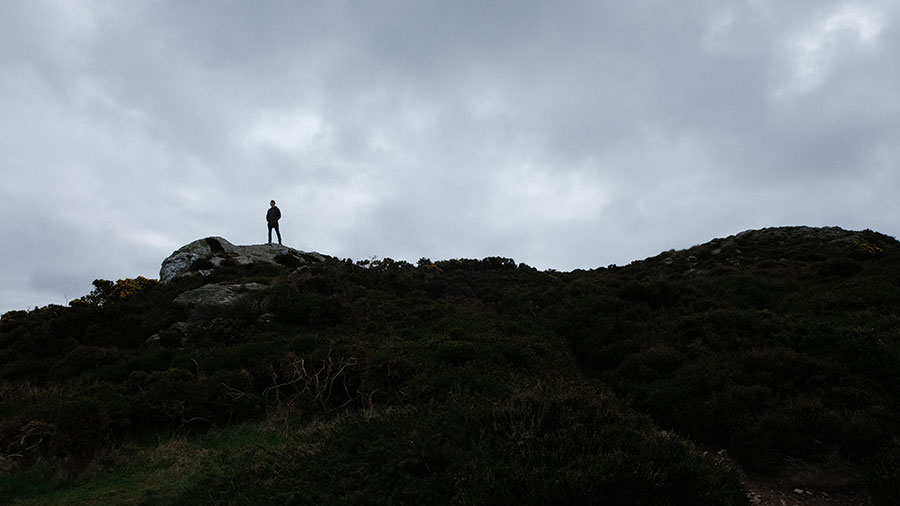
I open LinkedIn and within two minutes I get an uncomfortable feeling. I'm not exaggerating. It's a pattern I've recognised for more than ten years. In 2016, in 2022, today. It was like that when I created my profile in 2014 and it's still like that now. Always the same feeling: people making grand statements about the profession, people celebrating themselves, people whose bluff I once called, who now package that neatly in a post or ramble away on some podcast. They all seem to claim they have the answer to everything. And I doubt myself.
For a long time I thought that was on me. And in a way it is. But it made me think I didn’t belong in marketing. It fed something I’d been dealing with my entire career. Imposter syndrome*. But was I the imposter? Or is it the LinkedIn regulars? Maybe I just need to get over myself. Maybe. But there’s substance to my self-doubt, and it goes hand in hand with competence more often than you’d think (see also the Dunning-Kruger effect²).
Self-doubt from the very beginning
I started as a student at an e-commerce company doing basic copy-paste work, without a degree, because my parents had rightly decided that if I still wanted to study, I could pay for it myself. I paid for my own education, studying part-time through distance learning while working, and earned a Bachelor’s degree in business management. In the meantime I worked my way up to manager and right-hand to the managing director. I’ve now been involved at two companies where I was fully or partly responsible for the entire scope of their marketing efforts. At both, we brought in marketing agencies at some point for one project or another. For extra capacity, a fresh perspective, because a specific market required more specialised knowledge, or because I doubted whether I had enough capacity to handle it all myself. Every time, I could pick apart the pitch, and often we eventually reached the conclusion that I had predicted the approach and the outcome. I don’t want to bash marketing agencies too much, because it’s not black and white. But they do seem to have too little time to truly understand the business model or product well enough to know what approach is actually needed. I find that a real shame.
But still. LinkedIn, the podcasts, the thought leaders, the people who are always sure of themselves and build their own name as a brand, who respond to every trending topic with an opinion that makes no sense but looks good. The disruptors and the growth hackers. All those buzzwords give me a real aversion. I do believe in networking, but not in networking for the sake of networking, not in broadcasting every minor professional update to signal who you are and who you associate with. That is not who I am. And because it’s not who I am, I wondered whether I simply didn’t understand it, or whether there was something lacking in me. I felt like I had to choose between my integrity and becoming a successful marketer. At a certain point I thought: will I eventually be found out? Would I be better off as a baker? Which professions are actually free from the LinkedIn performance?
Career coaching gave me insight
In 2023 a lot came at me at once. New life, farewell to life, a new job in the chaos. I couldn’t just sit still with those thoughts running in the background. So I started career coaching with Nathalie Vandelannoote, career counsellor. Because I was genuinely wondering whether I should be heading in a different direction. Do my talents actually match what I do? Through aptitude tests and personality assessments we reached the conclusion that I was more or less where I was supposed to be: analytical thinking, strategic thinking and language skills are my strongest traits. And that self-doubt, that tendency to never simply be certain of my own approach, is exactly what sets me apart from the rest. Marketers are often seen from the outside as smooth talkers. And a marketer who constantly echoes what everyone else is saying stops looking critically at their own approach. They end up focusing more on how their personal brand feels than on what’s actually right. I struggle with that because it feels like it undermines my integrity.
What LinkedIn actually teaches me
I still go on LinkedIn sometimes. The feeling is always the same. LinkedIn is a good platform, especially for marketers: personal branding is a legitimate way to make your expertise visible, and people who are good at it deserve respect for that. But LinkedIn measures activity. Whoever posts regularly, engages and stays visible is rewarded by the algorithm; whoever is busy behind the scenes doing the actual work, less so. For some people that visibility comes naturally, it fits who they are. For me it doesn’t. I would rather do good work than post about it for attention. And that feeling of mismatch with what the platform expects made me think for a long time that there was something lacking in me. In the meantime I do write about my experiences, because it can help my business. The step towards playing the LinkedIn game is closer than I’d like, because my website alone will never generate the visibility my company needs. The irony of this entire article is that I need to learn to put the future of my business above my false sense of integrity. And maybe that’s just daring to step out of my comfort zone. Even if it means simply sharing the articles I write on my website, nothing more. In which case this might well be the first.
Why self-doubt is useful in this profession
Marketing appears to be a field full of people claiming to have reinvented the wheel, marketing agencies that treat industry benchmarks as sacred without understanding how your product or company actually works. Consultants who already have the answer before they’ve heard the question, and reports that look good but measure the wrong things. Marketing people who are essentially salespeople in disguise. Self-doubt makes you specific. You show the data and you keep the nuance. When you doubt yourself you won’t make empty promises. You’re simply honest about what you expect.
What my father unknowingly taught me
My father had a muscle disease, overcame two cancers but unfortunately lost the third in 2023. Less than a year before he died he completed the pilgrimage to Compostela. Less than a month before he died he simply kept going to work. He did all of that without asking for sympathy. Those who want to read more can do so here. His life was of course more than all those setbacks, but the way he faced those setbacks taught me an enormous amount. Feeling sorry for yourself doesn’t get you anywhere. I used to think I would maybe have my own company ‘one day’ but that moment taught me I had to go for it immediately. I’m glad I decided to become self-employed without waiting until I felt certain enough. Otherwise I would still be waiting. And this marketer with the classic case of imposter syndrome turns out to be standing on firmer ground because of it. And after writing and rereading this article, I realise that the whole LinkedIn thing will be a logical step for my business. Some will see that as hypocrisy. Mea culpa.
* Imposter syndrome is a psychological phenomenon where you feel that despite your qualities and achievements, you have undeservedly reached where you are. You feel inadequate compared to others.
² Dunning-Kruger effect: The opposite of imposter syndrome, the effect whereby amateurs grossly overestimate themselves because they cannot oversee the complexity.